Author: Nanjie Ma ORCID: 0009-0002-4415-1209 Email: phoenix-mx@hotmail.com Date: April 2026 Corresponding paper: The Nature of Reality: The Quantum Narrative Matrix Hypothesis
Abstract
Seventeen fundamental cosmological parameters can be read off from the statistical properties of a unitary matrix ensemble U(N)U(N); the only inputs required are the Euler triad (π,e,i)(π,e,i) together with the matrix dimension N=21N=21.
ππ encodes spatial closure, ee encodes temporal evolution, ii selects complex quantum structure, and NN fixes the number of degrees of freedom — the four are unified through the complex exponential eiθeiθ.
Of these 17 parameters, 15 align with Planck 2018 and 2020 best-fit values within 1σ1σ. Three-level null tests yield p<0.001p<0.001. This supplement provides the interpretive framework, epistemic boundaries, and research-programme context for those archived numerical results.
This note archives the premise-chain motivating dynamic mathematical structure in a pre-spacetime regime: without operational physical law as external anchor, a math–information layer self-constrains; seeking closure is dynamic relative to a fixed snapshot; closure is narratively identified with freeze, spacetime emergence, and late-universe effective laws. The chain is stipulative within an interpretive package, not a theorem of Pipeline A numerics.
§2–§3 state document scope and sharpen key phrases; §4 expands the premise chain; §5 collects objections and responses; §6–§7 supply glossary and arrow discipline; §8 is the ππ special topic (§8.1–§8.6); §9 gives a compact comparison (matrix in §9.2, QNM's distinctive output in §9.3; narrative detail omitted per §9.1); §10 centers on §10.0 (Euler triad) and §10.4 (eiθeiθ / unitary thread), with §10.1 as short cross-links to §4/§5/§8 — not a third repetition of those sections. Longer dual-pipeline notes, derivation checklists, programme outlines, FAQ, non-claims tables, and extended honesty material are not part of this public document; additional technical extensions may be maintained in the project repository and are not required to reproduce the archived Pipeline A numerics cited above.
Figure 0 (interpretive summary). Within the QNM narrative, eiθeiθ ties together ππ, ee, and ii in three roles (space, time, complex structure), which are then posited to connect to a U(N)U(N) ensemble with N=21N=21, GUE eigenvalue statistics, a deterministic mapping FgeoFgeo (17 formulae), 17 cosmological outputs, and the archived comparison to Planck (15/17). This figure is a roadmap, not a theorem.
1. Document scope and status
1.1 What this supplement is
This supplement accompanies the main QNM manuscript. It addresses a specific question that the main text raises but does not fully develop:
Why attribute dynamic mathematical structure to a pre-spacetime phase, rather than treating all mathematical structure as timeless (à la Tegmark's MUH)?
The answer offered here is a premise chain (P1–P6), not a theorem. Each step is labeled as interpretive, stipulative, or conjectural. The chain is designed to be modular: rejecting any single premise breaks the narrative but does not invalidate Pipeline A's archived numerics.
1.2 What this supplement is not
- Not an extension of the main text's numerical claims
- Not a proof that pre-spacetime dynamics occurred
- Not a claim that QNM is the unique framework explaining 15/17 alignment
- Not a replacement for formal first-principles derivations of the mapping (catalogued in the internal extension archive)
2. Key term definitions
The following terms carry specific operational meanings within the P1–P6 premise chain. These definitions are internal to this supplement and do not override standard physics usage.
TermMeaning in P1–P6What it is NOTPhysical law (operational)Effective rules and constants read off by late-universe phenomenology and comparison protocols (e.g., Pipeline A's Planck scalar screen)Not every logically true mathematical statementExternal anchorA pre-given world-law package that selects which mathematical structure is the realized universe, without an internal closure storyNot a physical constant; not a measurement deviceSelf-consistency / closureCompatibility of encoding rules, composition rules, and structural identities within the posited fundamental layerNot uniqueness; not an algorithmic closure procedureDynamics (P3–P5 sense)The posited process by which mutually compatible rules and encodings are sought — not a formal algorithm but a motivated analogy (cf. Connes's modular flow)Not dynamics in physical time; not a simulation running on hardwareFreezeThe narrative label for the moment when self-consistency iteration converges — the converged configuration is identified with effective physical lawNot a literal phase transition in physical spacetimePre-spacetimeThe posited era before the freeze, when neither stable spacetime metric nor fixed physical constants exist as operational quantitiesNot a period in cosmological time; not “before the Big Bang” in the standard sensePost-freezeThe era after convergence, when physical law, spacetime, and measured constants are operationally definedCorresponds to standard late-universe physics
2.1 Why these definitions matter
Without explicit definitions, terms like “dynamics” and “pre-spacetime” invite equivocation. A critic might read “pre-spacetime dynamics” as claiming that a literal physical process occurred before spacetime — which is not the claim. The claim is narrower: that the algebraic self-consistency of the mathematical structure can be modeled as an iteration, and that this modeling is productive (it organizes the dual-pipeline observations into a coherent narrative).
3. Precision tightening of key assertions
3.1 The phrase “dynamic mathematical structure”
Loose version (main text §2.1): “Mathematical structure is dynamic in the pre-spacetime phase.”
Tight version (this supplement): “Within the P1–P6 interpretive package, the algebraic relations defining the posited fundamental layer are modeled as undergoing self-consistency iteration (P3–P4). This iteration is labeled ‘dynamic' relative to the single frozen configuration that constitutes effective physical law (P5). The label does not imply that a literal clock measures the iteration, nor that the iteration is an algorithm running on external hardware.”
3.2 The phrase “freeze” / “crystallization”
Loose version: “Physical law crystallizes when mathematical structure freezes.”
Tight version: “The convergence endpoint of the posited self-consistency iteration is narratively identified with the configuration whose statistical properties Pipeline A maps onto Planck-scale parameters. ‘Freeze' is a metaphor for convergence, not a literal thermodynamic phase transition.”
3.3 The phrase “mathematics precedes physics”
Loose version: “Mathematics is more fundamental than physics.”
Tight version: “Within P1–P6, the algebraic layer is posited to be logically prior to operational physical law — in the sense that the compatibility conditions of the algebra must be satisfied before the effective rules and constants can be read off as ‘physics.' This is a claim about logical ordering within the interpretive package, not a claim about temporal ordering in physical cosmology.”
3.4 The transition labels (P-chain)
P1 → P2 — Worldview stipulation. Without late-universe anchors, compatibility must be sought internally.
P2 → P3 — Motivated analogy. Internal compatibility-seeking without external rules constitutes algebraic self-consistency iteration (cf. Connes modular flow as mathematical precedent).
P3 → P4 — Definitional. Self-consistency iteration, viewed relative to the single frozen state, is labeled “dynamic”.
P4 → P5 — Conjecture. The iteration converges; the convergence endpoint = effective physical law.
P5 → P6 — Narrative bridge. Labels the convergence as “freeze” / “emergence” to connect with the main text's dual-pipeline story.
Key point: Denying any row breaks the narrative but does not by itself overthrow Pipeline A's archived numerics. The 15/17 alignment is a numerical fact; the P1–P6 chain is an interpretation of that fact.
4. Premise chain P1–P6: expanded statement
4.1 Visual summary (mirrors main text §2.1)
Figure 4 collects premises P1–P6 and the boxed-conclusion gist; per-step tags and the independence notice are in the figure. Expanded commentary appears in §4.2.
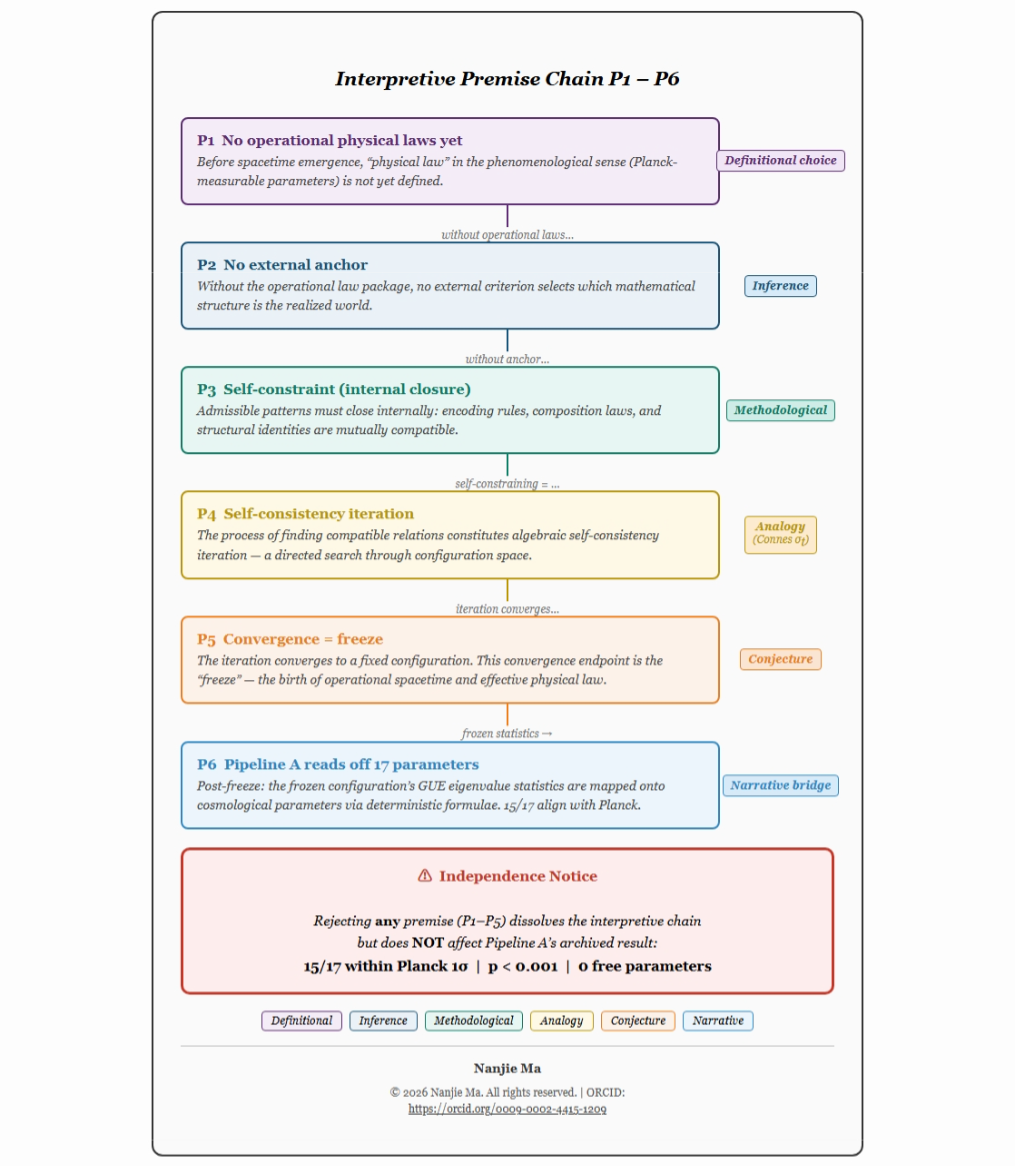 Figure 4. Visual flow of the interpretive premise chain (aligned with main text §2.1; includes per-step status tags and independence notice). English only.
4.2 Per-premise commentary
P1 — No operational physical laws yet
Content: Before spacetime and the late-universe comparison dictionary exist as operational entities, «physical law» in the phenomenological sense (the sense in which Planck measures H0H0, ΩbΩb, nsns, etc.) is not yet defined.
Clarification: P1 does not deny that mathematical truths (e.g., the properties of ππ) hold timelessly in the Platonic sense. It restricts «physical law» to the operational package read off by late-universe phenomenology.
Scope: This is a definitional choice — what counts as «physical law» — not a metaphysical claim about the existence of eternal truths.
P2 — No external anchor
Content: Without the operational law package, there is no external criterion to select which mathematical structure is the «realized» universe. The selection problem is open.
Connection to Tegmark: In Tegmark's MUH, all self-consistent structures are equally real, so the selection problem is dissolved by fiat. QNM does not accept this dissolution; instead, P3–P6 propose a mechanism (algebraic self-consistency iteration) by which one configuration is selected.
P3 — Self-constraint
Content: Without external anchors, compatibility must be achieved internally. The mathematical-informational layer's relations must be mutually compatible — encoding rules, composition rules, and structural identities must close without contradiction.
Mathematical precedent: This is structurally analogous to the requirement that a C⋆-algebra must satisfy its own axioms (associativity; compatibility of the involution with multiplication; norm completeness) without reference to any external structure.
P4 — Self-consistency seeking
Content: P3's requirement is not automatically satisfied. The process by which compatible relations are found — or fail to be found — constitutes algebraic self-consistency iteration.
Mathematical precedent: Connes's modular flow (Tomita–Takesaki theory): given a von Neumann algebra and a faithful state, a one-parameter automorphism group σtσt emerges from the algebra itself, without any external Hamiltonian. This is a proven theorem demonstrating that algebraic structure can generate its own «time-like» parameter.
Important caveat: P4 uses modular flow as an analogy, not as a derivation. QNM has not constructed a specific von Neumann algebra whose modular flow reproduces the pre-spacetime dynamics conjectured here. A former checklist numbering this gap lives in the internal extension archive (INTERNAL_Supplement_Extensions_20260402_EN.md).
P5 — Convergence = freeze
Content: The self-consistency iteration is posited to converge. The convergence endpoint is the configuration whose statistics Pipeline A maps onto Planck-era parameters. This convergence is narratively labeled the «freeze.»
Why convergence? If the iteration does not converge, there is no stable physical law — no universe to observe. The existence of observers is evidence (in a weak anthropic sense) that convergence occurred.
Honesty constraint: QNM has not proved convergence in a rigorous dynamical-system sense; a proof would belong to a first-principles derivation programme. Checklist-style notes on that gap are not part of this public supplement.
P6 — Operational bridge to Pipeline A
Content: After the freeze, the frozen configuration's statistical properties (GUE eigenvalue statistics) are mapped onto cosmological parameters via Pipeline A's deterministic formulae. The 15/17 alignment with Planck is the empirical anchor of the entire framework.
Key distinction: P1–P5 are interpretive. P6 connects to data. The 15/17 alignment is a numerical fact that does not depend on accepting P1–P5.
5. Per-premise objections and responses
5.1 Master objection table
PremiseStrongest objectionQNM responseResolutionP1«Eternal laws ground everything; there is no lawless era»QNM usage: P1's «physical law» = operational package read from late-universe phenomenology; timeless mathematical truth is not excluded. A reader who adopts ontologically complete physical law ab initio (denying any pre-history before the law-package is differentiated) conflicts with P1; P1–P6 does not apply under that stance. Archived 15/17 is logically independent of accepting P1Worldview-dependentP2«Tegmark: all structures exist; no selection needed»Even if all exist, which one is physically instantiated is a separate question. P2 targets that questionPhilosophically openP3«Why must closure be internal? Maybe brute-fact selection suffices»Brute fact = no explanation. P3 is the hypothesis that explanation exists. It is defeasibleMethodological choiceP4«Self-consistency seeking is not well-defined without specifying the algebra and iteration rule»Agreed. This is the main weakness. The internal extension archive lists algebra-specification steps as open workAcknowledged gapP5«Why should the iteration converge? Maybe no fixed point exists»Anthropic: we observe stable law → convergence occurred (weak argument). Mathematical: many algebraic iterations do converge (non-constructive)Partially addressedP6«The freeze metaphor adds nothing to ‘Pipeline A works on GUE input'»Fair. P6 is narrative glue, not independent content. The parsimonious reading is: Pipeline A works because the mapping is GUE-adaptedAcknowledged
5.2 The strongest composite objection
«P1–P6 is an elaborate narrative overlay on a simpler fact: you designed a mapping that works well on GUE matrices, and GUE matrices naturally contain ππ and ee. The ‘pre-spacetime dynamics' story adds interpretive color but no predictive content.»
QNM response:
This objection is partially correct and partially incomplete:
(a) Correct part: The current framework does not derive the mapping from first principles. Without such a derivation, the narrative layer is not empirically distinguishable from «well-designed GUE mapping.»
(b) Incomplete part: The objection does not explain why a GUE mapping should work at all — why should random matrix statistics have anything to do with cosmological parameters? The narrative (P1–P6) offers a possible reason: the cosmological parameters are the frozen statistics of a self-consistent algebraic configuration, and GUE is the maximum-entropy measure on that configuration space.
(c) Resolution path: The objection would be fully answered by deriving the mapping from algebraic first principles (former steps 1–6 in the internal archive). Until then, the objection stands as the strongest criticism of the interpretive layer.
5.3 What surviving P1–P6 scrutiny actually requires
For the premise chain to be productive (not merely self-consistent), it must eventually lead to:
- A specific algebraic structure (specified, not yet done)
- A derivation of at least some mapping formulae from that structure (open; see internal archive for a former numbered checklist)
- A prediction not already in the Planck data
Without these, P1–P6 remains a motivated but underdetermined interpretive layer. This is explicitly acknowledged.
5.4 Comparison with standard cosmology's interpretive layers
For perspective: standard ΛΛCDM also contains interpretive layers that are not fully derived:
ΛΛCDM interpretive layerStatus«Dark energy is ΛΛ (vacuum energy)»Consistent with data; not derived from QFT (the cosmological constant problem)«Inflation happened»Consistent with CMB; inflaton not identified; initial conditions unclear«Dark matter is a particle»Consistent with rotation curves; particle not detectedQNM's interpretive layer (P1–P6) is less mature than these — it lacks the quantitative track record of ΛΛCDM — but it is not categorically different in kind: all are frameworks whose interpretive components outrun their derivational foundations.
6. Glossary (narrow senses used here)
TermIntended meaning in P1–P6Physical law (operational)Effective rules and constants read by late-universe phenomenology and comparison protocols (e.g. Planck-class scalar screens on Pipeline A), not every logical truth of pure mathematics.External anchorA pre-given world-law package that picks which mathematical structure is the realized cosmos without an internal closure story. In P2, its absence is stipulated for the pre-emergence epoch.Self-constraint / closureCompatibility of encodings, composition rules, and structural identities within the posited essence layer; not claimed unique or algorithmically specified here.DynamicRelative to a fixed formal snapshot or internal update rule; not presupposed external cosmic time unless modeled (e.g. matrix time in toy dynamics).Freeze / emergenceHeuristic labels for transition to effectively static maps for late-universe comparison; no asserted statistical-mechanics critical point or literal clock.Realized structureThe physical-world configuration of relations and information carriers the framework treats as actual (in QNM: matrix-level states, maps, protocols), as opposed to the abstract existence of all consistent formal systems.Internal time / updateAny stepwise or ordered modification rule (e.g. simulation time in Pipeline B) used only as a pedagogical stand-in for «dynamics» when no cosmological t is assumed.
7. Logical status of the arrows (discipline)
The diagram uses ↓ between P1 and P6. None of these links is offered as a formal implication in proof theory or model theory.
StepIntended statusP1 → P2Interpretive: if «law» means the operational late-universe package, then before that package exists, salience of one structure over another is not fixed by that package.P2 → P3Stipulation / worldview: QNM adopts the stance that, absent such anchoring, coherence must be sought within the math–information layer (rather than imported wholesale from a pre-existing law book).P3 → P4Clarification of vocabulary: «self-constraint» is spelled out as hunt for mutually compatible rules and encodings—not a formal algorithm.P4 → P5Definitional for this package: «seeking» closure is treated as dynamic relative to any single frozen formalization of the state.P5 → P6Narrative bridge: closure is labeled freeze / emergence / operational law for story coherence with the rest of the manuscript.Takeaway: rejecting any row blocks the story but does not, by itself, invalidate archived numerics in Pipeline A.
8. The ππ special topic: relational invariant, ubiquity, and epistemic limits
Abstract vs.\ operational (discipline for Platonist / MUH readers). P1–P6 does not claim that formal systems like ZFC «became true» at an epoch; it concerns which large pattern functions as the realized physical substrate before a late-universe law package is frozen—possibly underdetermined and reorganizing in the narrative. Familiar MUH-style pictures often treat structure as timeless; QNM's reading foregrounds that pre-freeze layer (Section 7.8.2). Named programmes (Wheeler, Smolin, Tegmark/MUH, Connes) are compared compactly in §9 (§9.0–§9.3); see §9.1 for what is omitted in the public file.
8.1 ππ as a relational invariant — what standard mathematics establishes
8.1.1 Three facts about ππ that are theorems, not conjectures
Fact 1. ππ is a constraint-satisfaction output.
ππ is not «put into» geometry by convention. It emerges whenever a closed curve of maximal area-to-perimeter ratio is sought:
Isoperimetric theorem:  4πA ≤ L²
Equality iff the curve is a circle.
ππ is the unique numerical value that satisfies this extremal constraint. In this precise sense, ππ is the answer to a self-consistency question: «What shape simultaneously maximizes area and minimizes boundary?» The answer is a circle, and its metric is ππ.
Fact 2. ππ is the period of the complex exponential.
e^{iθ} has minimal period 2π.
e^{i·2π} = 1.
This is not a definition — it is a consequence of the differential equation f′(z)=if(z)f′(z)=if(z), f(0)=1f(0)=1, whose unique solution is f(z)=eizf(z)=eiz. The period 2π2π is forced by the equation; no one chooses it.
Fact 3. ππ appears in domains with no obvious geometric content.
DomainFormulaGeometric content?Number theoryζ(2)=π2/6ζ(2)=π2/6 (Euler 1735)None obviousProbabilityNormal distribution: (1/2π)e−x2/2(1/2π)e−x2/2None obviousCombinatoricsStirling: n!≈2πn(n/e)nn!≈2πn(n/e)nNone obviousRandom matricesGUE spacing: (32/π2)s2e−4s2/π(32/π2)s2e−4s2/πNone obviousPhysicsCoulomb: F=q1q2/(4πε0r2)F=q1q2/(4πε0r2)Spherical symmetryGravitationGμν=8πGTμνGμν=8πGTμνSolid angle / GaussThe non-geometric appearances (number theory, probability, combinatorics) are the most striking. They show that ππ is not «about circles» — it is about constraint satisfaction in continuous systems with complex or rotational structure.
8.1.2 Why ππ appears everywhere — the standard explanation
The standard mathematical explanation (not specific to QNM) is:
ππ appears whenever a mathematical framework simultaneously involves (a) continuity, (b) complex or rotational structure, and (c) extremal or normalization constraints.
This is because:
- Continuity → calculus → integrals
- Complex/rotational structure → eiθeiθ → period 2π2π
- Extremal constraints → saddle-point integrals → Gaussian → ππ normalization
Since most of fundamental physics satisfies (a)+(b)+(c), ππ appears in most of fundamental physics. This is a mathematical tautology, not a mystery.
8.1.3 What the standard explanation does NOT address
The standard explanation tells us how ππ enters specific formulae. It does not address:
- Why the universe satisfies (a)+(b)+(c) in the first place — why continuity, complex numbers, and extremal principles?
- Whether there is a single algebraic root from which all appearances of ππ descend, or whether each appearance is independent
- Whether ππ's value is contingent (could be different in a different universe) or necessary (the same in all possible mathematical structures)
Question 3 has a definitive answer: ππ is mathematically necessary — its value is determined by the axioms of real analysis and cannot differ. Questions 1 and 2 remain open: question 2 is what §8.4 separates via readings (X) vs (Y); question 1 is not settled here and is taken up at programme level in §10.
8.2 Epistemic boundary: what standard mathematics supports and does not support
This subsection is an honesty checkpoint. It separates what can be said with mathematical certainty from what requires interpretive extrapolation.
8.2.1 Supported by standard mathematics
StatementStatusProofππ is transcendentalTheoremLindemann 1882ππ is the period of eiθeiθTheoremComplex analysisππ appears in GUE statisticsTheoremMehta 2004ππ appears in isoperimetric inequalityTheoremClassicalππ appears in Einstein equation (8πG8πG)DerivedGauss theorem + EFE derivationGUE (β=2β=2) ≠= GOE (β=1β=1) ≠= GSE (β=4β=4)TheoremDyson 1962Complex structure (ii) selects GUETheoremDyson classificationeiπ+1=0eiπ+1=0TheoremEuler 1748
8.2.2 NOT supported by standard mathematics alone
StatementStatusWhat would be neededππ's appearances share a single algebraic rootConjectureA unifying derivationππ «encodes spatial closure» in a physical senseQNM interpretationDerivation from U(N) theoryee «encodes temporal evolution» in a physical senseQNM interpretationDerivation from modular flowThe universe's rotational symmetry originates from a matrix substrateQNM conjectureRequires algebraic derivation programme (internal archive checklist)(π+e)(π+e) as additive coupling has physical meaning beyond numerologyQNM conjectureDerivation of orthogonality of generatorsPre-spacetime «dynamics» literally occurredInterpretive packageNot empirically testable by current methodseiπ+1=0eiπ+1=0 has cosmological contentMnemonic (§10.0.4)Would need to be promoted to theorem
8.2.3 The gap between §8.2.1 and §8.2.2
The entries in §8.2.1 are facts. The entries in §8.2.2 are conjectures or interpretations. The intellectual honesty of this supplement depends on never conflating the two. Specifically:
- Citing §8.2.1 entries as evidence for §8.2.2 entries is invalid without additional derivation
- The §8.2.1 entries are consistent with the §8.2.2 entries but do not entail them
- The §8.2.2 entries could all be false while the §8.2.1 entries remain true
8.3 The epistemic ladder: from archived 15/17 upward
How much interpretive weight can the data support? This subsection arranges claims in order of increasing speculation, with explicit markers for where the data run out.
LevelClaimBasisConfidenceL0Pipeline A produces 17 mapped valuesCode outputCertainL115/17 align with Planck within 1σ1σArchived comparisonCertainL2Alignment survives three-level null test (p<0.001p<0.001)L1/L2/L3 surrogatesHighL3The mapping uses only π,e,i,N=21π,e,i,N=21Code inspectionCertainL4The compression 4→17 is non-trivialL1 surrogate: random constants achieve ≤14/17≤14/17HighL5GUE (not GOE/GSE) is requiredNot yet tested with GOE/GSE inputUnknownL6ππ and ee play structurally distinct roles (space vs.\ time)Section 3.8 argument in main text; not independently derivedFramework-dependentL7The (π+e)(π+e) coupling reflects orthogonality of generatorsConceptual argument; not derived from representation theorySpeculativeL8The mapping formulae are derivable from U(N) theoryNot attemptedAspirationalL9A pre-spacetime algebraic iteration preceded the freezeP1–P6 narrativeInterpretiveL10The matrix substrate is ontologically fundamentalQNM axiomMetaphysicalThe solid ground is L0–L4. L5 is testable and should be tested. L6–L7 are framework-dependent arguments that could be strengthened by derivation. L8–L10 are research targets, not achievements.
Rule of thumb: When discussing QNM externally, cite only L0–L4. When discussing QNM internally (research directions), L5–L8 define the work programme. L9–L10 are philosophical commitments that motivate the programme but do not constrain it.
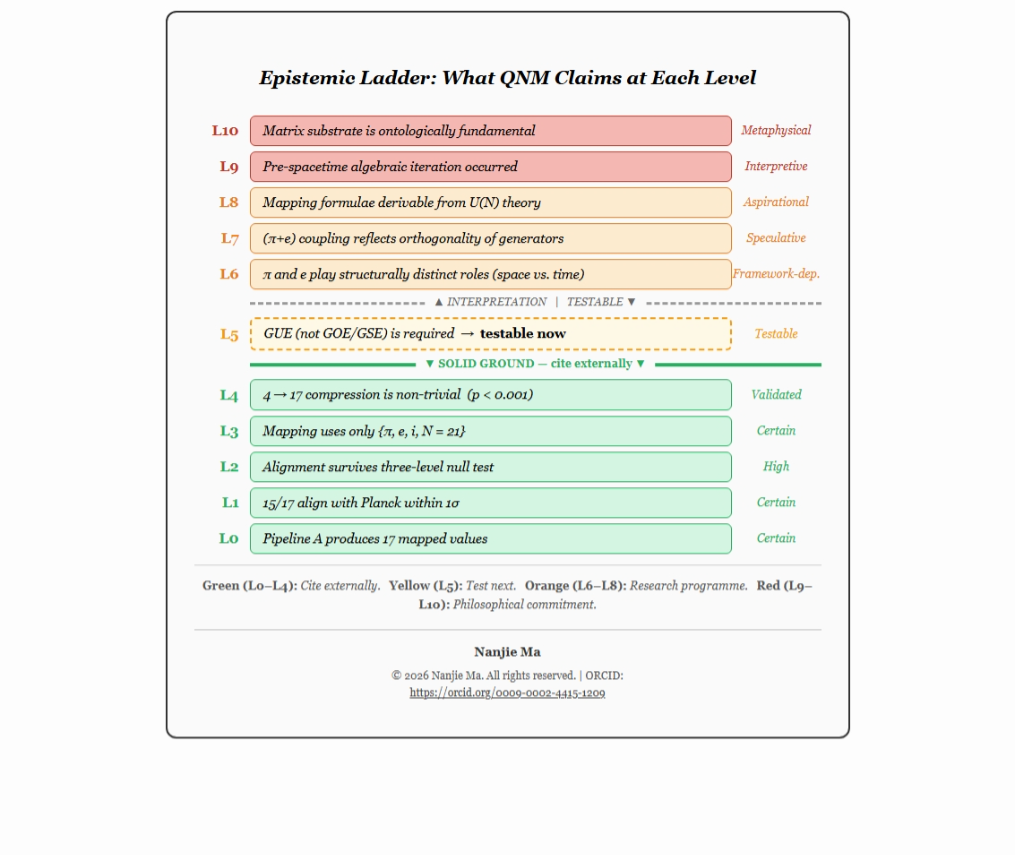
Figure 2. Visual summary of the epistemic ladder (same levels as the table above). English labels only; green band L0–L4 is the externally citable tier.
8.4 ππ in the matrix ensemble vs.\ ππ in the mapping formulae
8.4.1 The circularity concern
A reviewer may object:
«GUE statistics contain ππ. Your mapping uses ππ. The match is tautological.»
This concern has merit and must be addressed directly.
8.4.2 Three distinct ππ-sources
SourceExamplesChosen by author?(A) Matrix ensembleGUE density (2/Nπ)…(2/Nπ)…; spacing (32/π2)s2exp(−4s2/π)(32/π2)s2exp(−4s2/π); Gaussian measure (1/π)exp(−∣z∣2)(1/π)exp(−∣z∣2)No — mathematical theorems(B) Mapping formulaeΓspace=πΓspace=π; spectral projector coefficients; angular scalingYes — author's construction(C) Target physics8πG8πG; spherical harmonics; CMB angular spectrum; Bekenstein–Hawking entropyNo — standard physics
8.4.3 Two readings
(X) Circular reading: Source (B) borrows ππ from source (A). The mapping is designed to exploit the fact that GUE already contains ππ. The match with source (C) is then a consequence of «π≈ππ≈π» — not deep.
(Y) Structural reading: Sources (A), (B), and (C) all contain ππ for the same reason — they share the unitary algebraic root (U(N) symmetry). The mapping's use of ππ is not circular but consistent: it preserves the algebraic structure that generates ππ at all three levels.
8.4.3.1 Expanded structural reading: the eiθeiθ programme (full QNM-internal statement)Under QNM's structural reading (Y), the narrative packaging in §10.4.5 treats the complex exponential eiθeiθ as the single unifying analytic object through which the seventeen Pipeline A mapping formulae are conceptually threaded with the matrix substrate. In that story, eiθeiθ simultaneously:
- anchors the unitary picture (e.g. U(N)=eiHU(N)=eiH for Hermitian generators HH);
- ties to the complex / GUE layer (Gaussian measures and phase structures in the complex-Hermitian GUE pipeline);
- packages the Euler triad: ππ as rotational period (ei⋅2π=1ei⋅2π=1), ee as the exponential base linking algebra to dynamics, and ii as complex structure.
QNM-internal motivating claim (not a theorem). The deposit does not treat this co-occurrence as mere ``numerological accident'': the hope is that eiθeiθ is the common algebraic ancestor at the matrix layer and that the observable universe is read, phenomenologically, as a projection through the declared spectral--cosmology map (schematically FgeoFgeo in Figure 0 above). This aligns with (Y); it is not implied by L0--L4 alone and does not refute (X) without a derivation.
Honesty firewall. It would overshoot the evidence to claim all seventeen routes are already uniquely derived from eiθeiθ. §10.4.5 states the QNM-specific upgrade: the precise functional forms should be derivable from U(NN) representation theory---not yet archived.
Epistemic ladder. That target is L8 (Aspirational; §8.3). Framework-dependent / speculative labels attach to L6--L7, not L8. Upgrading this story means executing L8---not relabelling numerics. (Main text §5.3.3.5 duplicates this block for reviewers who cite the paper only.)
Discriminating (X) vs (Y) by derivation, and the accompanying schematic figure, are archived in _internal/INTERNAL_Supplement_Extensions_20260402_EN.md (not part of the public supplement).
8.5 The full ππ inventory across scales (condensed)
For reference, a condensed list of where ππ appears across the physical scales covered by the QNM framework:
Scaleππ manifestationMechanism linkPlanckℓPℓP, tPtP defined via ℏℏ, GG, cc; GG enters with 8π8πIII (projection)Quantumℏ=h/2πℏ=h/2π; Schrödinger phases eiEt/ℏeiEt/ℏI (structure) + II (dynamics)NuclearStrong coupling runs via ββ-function; loop integrals contain ππII (dynamics)AtomicBohr radius a0a0; fine structure αα; hydrogen orbitals YℓmYℓmI + IIIMolecularRotational spectra; molecular symmetry groupsIII (projection)StellarHydrostatic equilibrium; Eddington luminosity contains 4π4πIII (projection)GalacticSpiral structure; rotation curves; angular momentumIII (projection)CosmologicalFriedmann H2=8πGρ/3H2=8πGρ/3; CMB CℓCℓ; BAO angular scaleIII (projection)InformationShannon entropy log2log2; channel capacity; holographic bound A/4=πr2/ℓP2A/4=πr2/ℓP2I (structure) + IIIObservation: ππ appears at every scale. Within the QNM framework, this is tentatively attributed to the unitary structure of the matrix substrate propagating through all levels of emergence. Within standard physics, it is attributed to the ubiquity of rotational symmetry and Gaussian integrals.
8.6 Summary of §8
QuestionAnswerBasisIs ππ special?Yes — transcendental, universal, constraint-generatedTheoremWhy does ππ appear everywhere?Continuity + complex structure + extremal constraintsStandard mathDoes QNM add anything to this understanding?Possibly — if the unitary matrix substrate can be shown to be the common rootConjectureIs the mapping's use of ππ circular?Two readings (X, Y); currently undecidableNeeds formal derivation from stated algebraCan standard math alone prove pre-spacetime dynamics?No§8.2.2What is the epistemically safe claim?L0–L4 (§8.3): 4 inputs, 17 outputs, 15/17 align, p<0.001p<0.001Data
9. Comparison with related programmes: Wheeler, Smolin, Tegmark (MUH), and Connes
9.0 Purpose of this section
QNM draws on ideas that have precedents in the foundational physics literature. This section locates QNM relative to four major programmes, identifying what is borrowed, what is modified, and what is new. The goal is intellectual honesty: QNM should not appear to claim originality where it is building on existing ideas, nor should it be conflated with programmes from which it substantively differs. In this public file, narrative comparisons are compressed (§9.1); the comparative matrix is §9.2, and the distinctive QNM output is §9.3.
9.1 Public version: narrative comparisons omitted
Wheeler, Smolin, Tegmark (MUH), and Connes each merit careful, citation-rich discussion — but programme-by-programme summaries are not what most readers need to assess QNM's archived numerics and epistemic ladder. Those narratives would also re-cover themes already developed in §4 (P1–P6), §5, and §8 (especially contrasts with timeless MUH-style readings).
This public supplement therefore omits the long-form Wheeler / Smolin / Tegmark / Connes subsections that earlier drafts carried under legacy §9.1–§9.4 numbering. The feature matrix in §9.2 encodes the comparative dimensions QNM relies on. §9.3 states the distinctive quantitative takeaway in one place. Longer comparative write-ups may exist in project-only materials for collaborators; they are not part of this public file.
9.2 Summary comparison table
FeatureWheelerSmolinTegmarkConnesQNMInformation is fundamental✓—✓—✓Mathematics is constitutive~—✓✓✓Selection mechanismParticipatoryDarwinianNone/anthropicAlgebraic (spectral)Algebraic (convergence)Pre-spacetime phase~✗✗ (timeless)~ (modular flow)✓ (P1–P6)Specific predictions✗~✗~ (Higgs mass)✓ (17 parameters)Mathematical rigourLowMediumLowVery highLowFalsifiable✗~✗~✓Community sizeLarge (historical)MediumMediumMediumSingle authorMaturityDecadesDecades~20 yearsDecadesInitial
9.3 What QNM uniquely contributes (if validated)
Across all four comparisons, QNM's unique contribution would be:
A specific, falsifiable mapping from a defined matrix ensemble (π,e,i,N=21π,e,i,N=21) to 17 cosmological parameters, with 15/17 alignment at 1σ1σ and p<0.001p<0.001 against three-level null models.
No other programme listed above produces this specific quantitative output. Whether the output is deep (reflecting genuine algebraic structure) or shallow (a well-crafted numerical fit) is open; longer roadmap-style notes may exist in project-only materials.
10. Research Programme: Ideas Repository
Status. Interpretive horizon / research programme / ideas warehouse. Confined to this supplement. Does not elevate the CLAIMS_MATRIX, pre-registered null-model strength, or any numerical claim in the main text. §10 states philosophical / foundational motivations separately from archived numerics, for reference when asking where could this go next?
Organisation. §10.0 (Euler triad and coupling layers). §10.1 (short cross-links back to §4, §5, §8 — not a full re-argument). §10.4 (unitary / GUE / eiθeiθ thread). §10.5 notes that additional technical extensions may live in the project repository and are not included in this public document.
10.0 The Euler Triad (π,e,i)(π,e,i): Structural Skeleton of QNM
10.0.1 Why open with this
Every mapping formula in Pipeline A draws on at most four mathematical inputs: the Euler triad (π,e,i)(π,e,i) and the matrix dimension N=21N=21. No additional free parameters are fitted to cosmological data. This compression — 4 inputs → 17 physical outputs — is the single most falsifiable structural property of QNM: if any output required a fifth independent constant, the framework would fail.
Before the unitary / eiθeiθ narrative in §10.4, it is therefore useful to state how ππ, ee, and ii enter and what roles they play.
10.0.2 The three constants and their QNM roles
ConstantQNM roleMathematical originPhysical manifestationiiComplex structure: selects Hermitian matrices, determines GUE (not GOE or GSE)i2=−1i2=−1; Dyson's threefold classification (β=2↔β=2↔ complex)Quantum mechanics uses complex amplitudes; gauge phases are U(1)eeTemporal mode Γtime=exp(1)Γtime=exp(1): holographic Jacobian from information manifold to spacetimeUnique solution of df/dx=fdf/dx=f with f(0)=1f(0)=1; exponential map Lie algebra →→ Lie groupUnitary evolution U(t)=e−iHtU(t)=e−iHt; Boltzmann weight e−E/kTe−E/kTππSpatial mode ΓspaceΓspace: closure constant of compact spatial dimensionsPeriod of eiθeiθ: ei⋅2π=1ei⋅2π=1; normalization of spherical geometryEinstein equation 8πG8πG; spherical harmonics; holographic screen area 4πr24πr2
10.0.3 Two coupling layers
The three constants couple at two distinct mathematical levels.
Algebraic layer (Lie group / nonlinear).
U(N) = { e^{iH} : H Hermitian }Euler's identity eiπ+1=0eiπ+1=0 operates here. This encodes the full nonlinear structure of the unitary group.
Projection layer (Lie algebra / linear perturbation).
H=πTspace+eTtime[additive]H=πTspace+eTtime[additive]
The cosmological parameter σ8σ8 is computed at this layer:
σ8=σ8seed×(π+e)σ8=σ8seed×(π+e)
The coupling is additive (not multiplicative or exponential) because spatial and temporal degrees of freedom enter as orthogonal generators in the holographic Hilbert space — direct sum, not tensor product.
Connection between layers.
Lie algebraH=πTspace+eTtimeH=πTspace+eTtime [additive]Lie groupU=exp(iH)U=exp(iH) [exponential]The exponential map converts the additive (Lie algebra) structure into the multiplicative (Lie group) structure. Pipeline A's σ8σ8 formula operates at the Lie-algebra layer; Euler's identity operates at the Lie-group layer. Both are aspects of the same algebraic object.
10.0.4 Mnemonic reading of eiπ+1=0eiπ+1=0 (not a QNM theorem)
Within the QNM framework, the five symbols in Euler's identity can be associated — mnemonically, not deductively — with five structural roles:
SymbolMnemonic roleeeTemporal evolution (ΓtimeΓtime, holographic Jacobian)iiComplex structure (Hermitian matrices, quantum phases)ππSpatial closure (ΓspaceΓspace, compact-dimension modes)11Unit information (trace normalization, I=1I=1 nat)00Self-consistent closure (constraints satisfied, net residual =0=0)Reading: Temporal evolution (ee), acting through complex structure (ii) over one spatial half-period (ππ), plus unit normalization (11), yields complete self-consistent closure (00).
Firewall: This is a mnemonic, not a derivation. Euler's identity holds in all of complex analysis, not only in QNM. The QNM-specific content would be: deriving the particular functional forms in which ππ, ee, and ii enter the 17 mapping formulae from U(NN) representation theory — this derivation does not yet exist.
10.0.5 Correspondence with the three core mechanisms
The Euler triad maps onto QNM's three core mechanisms:
MechanismEuler constantRoleLayerI. Structure / TopologyiiSelects GUE (β=2β=2); fixes N=21N=21; determines algebraic DOFAlgebraicII. Matrix DynamicseeExponential map gives static algebra its evolution; Γtime=eΓtime=eLie groupIII. Holographic ProjectionππCompact-dimension closure; Γspace=πΓspace=π; spherical projectionGeometricMathematical support for each correspondence.
(i↔i↔ Structure): Dyson (1962) proved that the symmetry class of a random matrix ensemble is determined by whether the number field is real (GOE, β=1β=1), complex (GUE, β=2β=2), or quaternionic (GSE, β=4β=4). The presence of ii is the structural selector. This is a theorem, not a conjecture.
(e↔e↔ Dynamics): The exponential map exp:g→Gexp:g→G is the unique smooth homomorphism sending a Lie algebra generator to a Lie group element. Without ee, there is no passage from static algebra to dynamic evolution. Connes's modular flow σt=Δit=eitlogΔσt=Δit=eitlogΔ also uses ee as the bridge from algebraic modular operator to automorphism flow.
(π↔π↔ Projection): The Gauss divergence theorem on S2S2 produces 4π4π (solid angle). Einstein's 8πG8πG comes from this. Holographic screen area =4πr2=4πr2. Kaluza–Klein reduction of each compact dimension introduces ππ factors. The Bekenstein–Hawking entropy S=A/(4ℓP2)S=A/(4ℓP2) inherits ππ through A=4πrs2A=4πrs2.
What this does not establish: The number match (3 mechanisms = 3 constants) could be narrative organization rather than deep structure. A discriminating test would be: classify each of the 17 mapped parameters as «primarily structural», «primarily dynamical», or «primarily projective», then check whether the dominant constant (ii, ee, or ππ) in its mapping formula matches the classification. This test has not yet been performed.
10.0.6 Falsifiable compression — the sharpest claim
The observable universe's 17 cosmological parameters are a linear (Lie-algebra) projection of a nonlinear (Lie-group) complex unitary matrix structure, parameterized entirely by the Euler triad (π,e,i)(π,e,i) and the matrix dimension N=21N=21.
This is falsifiable: if any of the 17 parameters required a fifth independent constant beyond π,e,i,Nπ,e,i,N, the claim would fail. Currently 15/17 align within Planck 1σ1σ; the remaining 2 (τreionτreion, wawa) are identified as targets for future work.
10.1 Cross-links: self-consistency, emergence, and ππ (read §4, §5, §8)
The self-consistency / pre-freeze motivation, premise-by-premise objections and replies, and the full ππ / GUE inventory with (X)/(Y) readings are already developed in §4, §5, and §8. Repeating them here made the public supplement read as if the same case were argued three times.
Interpretive backbone: §4 (P1–P6), §5 (objections), §8 (ππ topic, epistemic ladder L0–L10, circularity subsection).
**This §10 block focuses on what is not duplicated there: the Euler triad packaging (§10.0) and the complex exponential / unitary narrative (§10.4**), i.e. the structural thread that ties those sections together through eiθeiθ.
Pointers retained from former §10.2/§10.3 material: (i) «Matrix as postulate vs output» — still an open research question; see §4.2 P6 and MAPPING_ASSUMPTIONS.md. (ii) Optional motivation-only note Supplementary_QNM_3_To_21_Information_Symmetric_Tensor_Sketch_20260410.md (counting stories for 21; not a derivation that the freeze layer is M21(C)M21(C) with GUE). (iii) ππ in ensemble vs mapping vs target physics, L1 surrogate, and (X)/(Y) — §8.3–§8.5.
10.4 The Unitary Foundation: Why GUE, Why ππ Pervades Physics, and the Spiral Connection
10.4.1 GUE vs. GOE vs. GSE — the choice matters
Pipeline A uses complex Hermitian (Ginibre) matrices, producing GUE statistics. This is consequential:
Complex Hermitian  →  GUE  (β = 2, U(N) invariant)
Real symmetric     →  GOE  (β = 1, O(N) invariant)     ← NOT used
Quaternion s.d.    →  GSE  (β = 4, Sp(N) invariant)    ← NOT used
GUE = unitarily invariant = U(NN) symmetry.
U(NN) contains U(1) as a subgroup. The structure constant of U(1) is 2π2π (the period of eiθeiθ). Therefore:
ππ enters the matrix ensemble because the ensemble has unitary (rotational) symmetry — and unitary symmetry is parameterized by ππ.
10.4.2 Rotational symmetry and ππ at every physical scale
Within the QNM framework, the choice of GUE offers a structural account of a well-known but rarely explained fact: rotational symmetry, and with it ππ, pervades physical law at every scale.
ScaleManifestationMathematical rootSubatomicSpin = SU(2) representationππ parameterizes SU(2)Quantum mechanicsComplex amplitudes, U(1) phasesππ parameterizes U(1)Gauge theoryU(1) ×× SU(2) ×× SU(3)All contain ππ via Lie group structureGeneral relativityGμν=8πGTμνGμν=8πGTμνππ from solid angle / Gauss theoremBlack holesA=4πrs2A=4πrs2Spherical geometryCosmologyCMB angular power spectrum CℓCℓSpherical harmonics contain ππAstrophysicsSpiral galaxies, accretion disks, orbitsAngular momentum conservation →→ rotation →→ ππBiologyDNA double helix, phyllotaxisChirality, rotational packing
10.4.3 Two readings (both consistent with all data)
(i) Standard physics (no matrix substrate needed): The universe has rotational symmetry. Rotational symmetry requires ππ. Both the matrix ensemble and physical law involve ππ because both involve rotational symmetry. No ontological priority of one over the other.
(ii) QNM conjecture (matrix substrate is foundational): The matrix algebra's unitary structure is the origin of rotational symmetry in physics. ππ appears in physical law because physical law inherits it from the matrix substrate. The ubiquity of spirals — from galaxies to DNA — reflects the ubiquity of U(NN) structure in the foundational algebra.
Reading (i) is more parsimonious. Reading (ii) is the QNM-internal interpretation. The present data do not distinguish between them.
10.4.4 Why quantum mechanics uses complex numbers
A related open problem in quantum foundations: why is quantum mechanics formulated over CC rather than RR or HH? (Hardy 2001; Chiribella et al. 2011; Renou et al. 2021 — the last providing experimental evidence against real-number QM.)
Within QNM, this has a direct answer: the matrix substrate is complex Hermitian (Pipeline A input), selecting β=2β=2 (GUE). The complex character of quantum mechanics is inherited from the matrix substrate's algebraic type.
This is framework-internal consistency, not proof — but it illustrates that QNM is structurally compatible with known physics rather than in tension with it.
10.4.5 The complex exponential as unifying thread
More precisely, the fundamental object is not ππ alone, nor ee alone, nor ii alone, but the complex exponential function eiθeiθ, which simultaneously encodes:
- ππ — rotational closure: ei⋅2π=1ei⋅2π=1
- ee — self-referential growth: ddxex=exdxdex=ex
- ii — complex extension: orthogonal rotation in the number plane
This single object:
- Defines the unitary group: U(N)=eiHU(N)=eiH
- Generates quantum evolution: U(t)=e−iHtU(t)=e−iHt
- Normalizes the GUE measure: (1/π)e−∣z∣2(1/π)e−∣z∣2
- Produces spherical harmonics: Yℓm∝eimϕYℓm∝eimϕ
- Underlies gauge invariance: ψ→eiα(x)ψψ→eiα(x)ψ
Within QNM, this recurrence is tentatively read as evidence that the matrix substrate's unitary structure is the common ancestor of all these appearances.
Firewall: The observation that eiθeiθ appears everywhere is a mathematical tautology once one accepts complex analysis and Lie groups. It holds in any framework, not only QNM. The QNM-specific content would be: the precise functional forms in which ππ and ee enter the 17 mapping formulae should be derivable from U(NN) representation theory — this derivation does not yet exist.
10.5 Additional material outside this public document
Additional technical extensions are maintained in the project repository and are not included in this public document. Longer checklists, extended FAQs, and defensive documentation for collaborators are not part of the public submission package and need not be consulted to reproduce Pipeline A numerics described in the main text and archived reports.
Empirical summary (for reviewers). Pipeline A maps a GUE-type 21×2121×21 Hermitian ensemble to 17 cosmological parameters using only π,e,i,N=21π,e,i,N=21 (no fitted constants); 15/17 within Planck 1σ1σ; three-level null tests p<0.001p<0.001. The mapping formulae, matrix dimension NN, and GUE ensemble choice are postulated and validated «a posteriori»; see the main text, MAPPING_ASSUMPTIONS.md, CLAIMS_MATRIX, and SEED_PLANCK_ALIGNMENT_REPORT.md. Deeper derivation roadmaps and extended Q&A are outside the scope of this public supplement.
11. Connection to main-text sections
11.0 Purpose
This section provides a cross-reference map between the interpretive material in this supplement and the numbered sections of the main QNM manuscript. Reviewers can use it to verify that every interpretive claim made here has a corresponding anchor in the main text — either as a numerical result, a mapping formula, or a stated assumption.
Open checks flagged in this supplement. The epistemic ladder in §8.3 lists L5 — whether GUE (rather than GOE or GSE) input is required for the archived 15/17 pattern — as not yet tested with ensemble substitutes in the public pipeline. Treat that row as an explicit honesty flag, not a completed result (see also §10.4.1).
11.1 Cross-reference table
Supplement sectionMain-text anchorRelationship§1 (scope)§1.1 (introduction)Supplement expands the interpretive context that §1.1 introduces briefly§2 (definitions)§2.1 (premise-chain box), §2.4 (three-layer reading notes)Supplement gives full definitions; main text gives compressed versions§3 (precision tightening)§2.5 (generative ontology)Supplement tightens the loose phrasings that §2.5 introduces§4 (P1–P6 expanded)§2.1 (premise-chain flowchart)One-to-one expansion: each P-step in the supplement corresponds to one box in the §2.1 flowchart§5 (objections)§7.8.2 (MUH comparison, dual-pipeline)Supplement provides per-premise critique that §7.8.2 only sketches§6 (glossary)§2.1, §2.4–§2.5 (premise-chain vocabulary)Supplement fixes narrow senses for P1–P6; main text uses shorter glosses§7 (arrow discipline)§2.1 (premise-chain flowchart)Supplement states which arrows are entailment vs narrative bridge§8.1–§8.2 (ππ as invariant)§3.8 (Γspace≡πΓspace≡π; (π+e)(π+e) packaging)Supplement gives mathematical background; main text gives the specific QNM application§8.3 (epistemic ladder)§5.3.3 (null-model hierarchy)Supplement maps confidence levels onto the null hierarchy§8.4 (circularity concern)§5.3.3.4 (L1 surrogate test)Supplement frames the two readings (X/Y); main text provides the data; derivation-based discrimination and Figure 3 schematic are internal (INTERNAL_Supplement_Extensions_20260402_EN.md)§8.5 (ππ across scales)§3.5 (62-row scale table)Supplement condenses; main text and associated figures give the full table§9.1–§9.3 (compact comparison)§7.8, §7.8.2§9.1 states public compression; §9.2 is the 5×7 matrix; §9.3 is the unique QNM output — narrative detail omitted§10.0 (Euler triad)§3.8 (ΓspaceΓspace, ΓtimeΓtime); §4 (mapping formulae)Supplement synthesizes; main text provides individual formulae§10.1 (cross-links)§4, §5, §8Pointers only; full arguments remain in those sections§10.0, §10.4 (Euler triad; eiθeiθ / unitary thread)§3.8, §5.3.3.4§10.0 packages inputs; §10.4 develops GUE / ππ / complex-exponential narrative§10.5 (note on additional material)§6 (Pipeline B), §7 (comparison); main text §8–§9 (boundaries, outlook)Additional material may exist in the project repository; it is not bundled in this public supplement — this row mirrors the §10.5 disclaimerEnd of supplementary material.
-