Document type: Supplementary note · post hoc structural disclosure on a fixed preregistered batch Version: 1.0 Date: 2026-04-09 Author: Nanjie Ma ORCID: 0009-0002-4415-1209
Accompanies: The Nature of Reality: The Quantum Narrative Matrix Hypothesis — main text §7.7.2.3 (P-R mapping rigidity; argmax N); six-layer disclosure index §5.3.3.1.1 (item ⑤ merges narrow + wide P-R).
Wide companion (1000×11N + EXT): Supplementary_P-R_WIDE_1000draws_11N_16-26_EXT_20260409_EN.md / .html. Source markdown (this note): Supplementary_P-R_NARROW_300draws_4N_19-22_Gap_Panel_20260409_EN.md.
1. Purpose
The preregistered P-R batch reports argmax N = 21 in 300/300 draws on {19, 20, 21, 22} under the documented four-κ multiplier class (r excluded mean aligned_count_17). A natural reviewer question is whether some draws were near ties. This note summarizes secondary analyses on the archived mapping_rigidity_N_drift_PR_per_draw.csv that quantify margins and give a variance decomposition on the 300 × 4 table of seed-averaged means.
This note does not extend the perturbation class, replace R2+ honesty limits, or claim global κ–N separability outside the archived domain.
1.1 Indexed disclosure stack (Pipeline A; N=21)
Skim-friendly index (same box as main text §5.3.3.1.1). Six distinct archived protocols; do not pool their metrics.
┌────────────────────────────────────────────────────────────┐
│ Pipeline A — indexed disclosure stack (working synthesis N=21) │
│ ════════════════════════════════════════════════════════   │
│ ① Cross-N 15/17 batch: ensemble-mean aligned_count_17     │
│    is highest at N=21 vs N=19–22 on frozen mapping.       │
│ ② Extended Planck comparator: RSS(%) global minimum at      │
│    N=21 among N∈[16,200] (20-trial archive); best in band. │
│ ③ R1 knob null: frozen mapping ~98.3rd percentile vs 1000 │
│    κ tuples (mean aligned_count_17; `r` excluded).         │
│ ④ B-1 derived S_8: lowest mean %-deviation at N=21 (~2.70%)│
│    on {19,…,22}; ties N=22 on 6/7 pass count.              │
│ ⑤ P-R κ drift (four κ_code branches; narrow + wide        │
│    extension, separate experiment_id): 300/300 on {19,…,22};│
│    1000/1000 on {16,…,26}; multi-way ties 0 in both.        │
│ ⑥ Gap & additive panels (post hoc): 300×4 — min Δ≈1.43,   │
│    η²(N)≈81.6%, η²(draw)≈17.5%, res≈0.98%; 1000×11 —       │
│    min Δ=1.00, mean≈2.04±0.24, η²(N)≈86.0%, η²(draw)≈11.1%,│
│    res≈2.88%; residual ≠ identified N×κ interaction.       │
│ → Disclosure stack, not uniqueness theorem or R2+ coverage.│
└────────────────────────────────────────────────────────────┘
2. Gap definition and summary statistics
For each draw_id, let A(N) denote the seed-averaged mean aligned_count_17 (r excluded) at matrix dimension N. Define the runner-up gap
Over n = 300 draws (JSON: PR_GAP_STRUCTURE_ANALYSIS_20260411.json):
QuantityValuemin(Δ)1.428571… (draw_id 84)max(Δ)3.0mean(Δ)2.083810…std(Δ) (population)0.228980…Reading: Every archived draw has strictly positive Δ; the tightest margin in this sample is still ≈1.43 counts on the 0–17 mean scale (not a near-tie at 10−1 resolution). This supports the disclosure that 300/300 is not driven by a handful of razor-thin wins within this CSV.
Tier language (disclosure only, not a theorem): min Δ ≥ 1.0 but < 1.5 in this archive → label moderate_min_gap_sample in the machine-readable JSON; do not rephrase as “inevitable for all future κ” or as proof of uniqueness.
3. Histogram of Δ (12 bins)
Counts are copied from the archived JSON (edges are data-adaptive between min and max Δ).
Bin [lo, hi)Count[1.4286, 1.5595)2[1.5595, 1.6905)2[1.6905, 1.8214)12[1.8214, 1.9524)27[1.9524, 2.0833)139[2.0833, 2.2143)57[2.2143, 2.3452)36[2.3452, 2.4762)9[2.4762, 2.6071)4[2.6071, 2.7381)5[2.7381, 2.8690)5[2.8690, 3.0000]2
4. Balanced panel: additive decomposition (one observation per cell)
Layout: 300 draws × 4 levels of N; one mean per (draw_id, N). Fit the additive model (grand mean + draw effect + N effect). Draw×N interaction is not separately identified and is absorbed in the residual (same layout_note as in the JSON).
Sourceη² vs total SSPartial η²N factor0.81550.9882Draw factor0.17470.9471Residual (additive + interaction)0.00976—F statistics (for completeness): FN ≈ 2.50×10⁴, Fdraw ≈ 53.7 (see JSON for df and MS).
Reading: Most total variance in the 300×4 panel is between N marginal profiles (η² ≈ 0.82 vs total). Partial η² for draw is also large because each draw shifts all four N columns together (κ-induced level); the JSON reading_note_en repeats this caution. Do not equate this decomposition with a proof of f(N,κ) = g(N) + h(κ) on unbounded κ or with independence from R2+ mapping heads.
5. Exploratory: Pearson r between Δ and each κ knob
Knob (branch on derive_projection_scale_factor)r(Δ, knob)kappa_normalization−0.110svd_entropy_weight−0.357compactness_scale0.031sqrt_c_eff_scale−0.164These are exploratory correlations on n = 300; they do not establish causality or monotonicity guarantees outside the sampled range. The largest |r| (≈0.36) still implies r²≈13% shared variance only—not a license to claim a theorem that no κ direction can collapse Δ; R2+ remains the honest candidate class for order-breaking perturbations.
Scalar perturbation size (exploratory). Let ‖ln κ‖₂ = √(∑i (ln κi)²) over the four knobs (κ=1 everywhere → 0). On n = 300, Pearson r(Δ, ‖ln κ‖₂) ≈ −0.061 (JSON key delta_vs_log_kappa_l2_norm). In this U[0.5,2.0]⁴ batch, larger ‖ln κ‖₂ does not show a strong trend toward smaller Δ; this is not a test of wider κ ranges.
6. Figure S-PR1 — κ knobs vs Δ
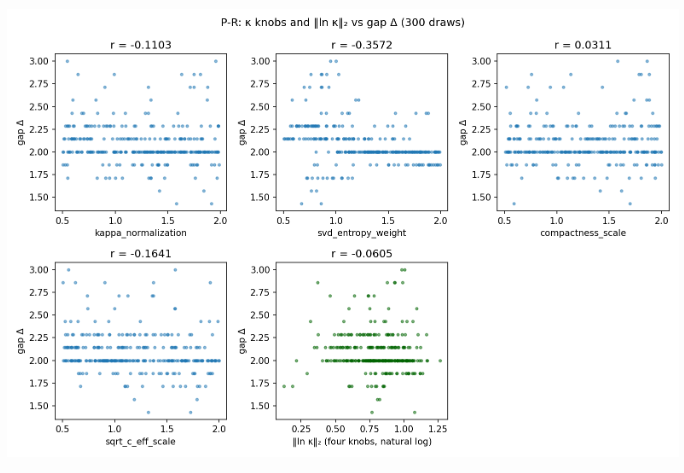 Figure S-PR1. Top row / bottom-left: each κ multiplier vs Δ; bottom-center: ‖ln κ‖₂ vs Δ; bottom-right subplot blank. Generated by 05_Core_Source_Code/F/scripts/analyze_PR_gap_structure.py (default PNG PR_gap_structure_kappa_vs_delta_20260411.png; copy in figures/ for bundling).
7. Reproducibility
ArtifactPath (repository root)Per-draw CSV05_Core_Source_Code/F/output/pipeline_A_planck/mapping_rigidity_N_drift_PR_per_draw.csvStructure JSON05_Core_Source_Code/F/output/pipeline_A_planck/PR_GAP_STRUCTURE_ANALYSIS_20260411.jsonScript05_Core_Source_Code/F/scripts/analyze_PR_gap_structure.pyReproduction index05_Core_Source_Code/REPRODUCTION.md §12Short review memo05_Core_Source_Code/F/output/pipeline_A_planck/MAPPING_RIGIDITY_N_DRIFT_PR_REVIEW_20260411.mdRegenerate JSON and PNG:
cd 05_Core_Source_Code
python F/scripts/analyze_PR_gap_structure.py
8. Honesty firewall (same as main text §5.3.3.1 spirit)
- Not all mapping perturbations; not R2+ spectral permutations or replacement heads unless separately preregistered.
- This HTML note conditions on the narrow 300×4 CSV (gap §2 uses N ∈ {19,…,22}). Wide batch: Supplementary_P-R_WIDE_1000draws_11N_16-26_EXT_20260409_EN.html.
- Secondary analysis is conditional on fixed preregistered archives; it strengthens margin disclosure but does not upgrade the claim to a uniqueness theorem or to complete coverage of effective degrees of freedom in the mapping.
End of supplementary note.
-