Author: Nanjie Ma (马楠杰) ORCID:
2.2 Second Tier: Thermodynamic Route (Entropic Force → Einstein Equations)
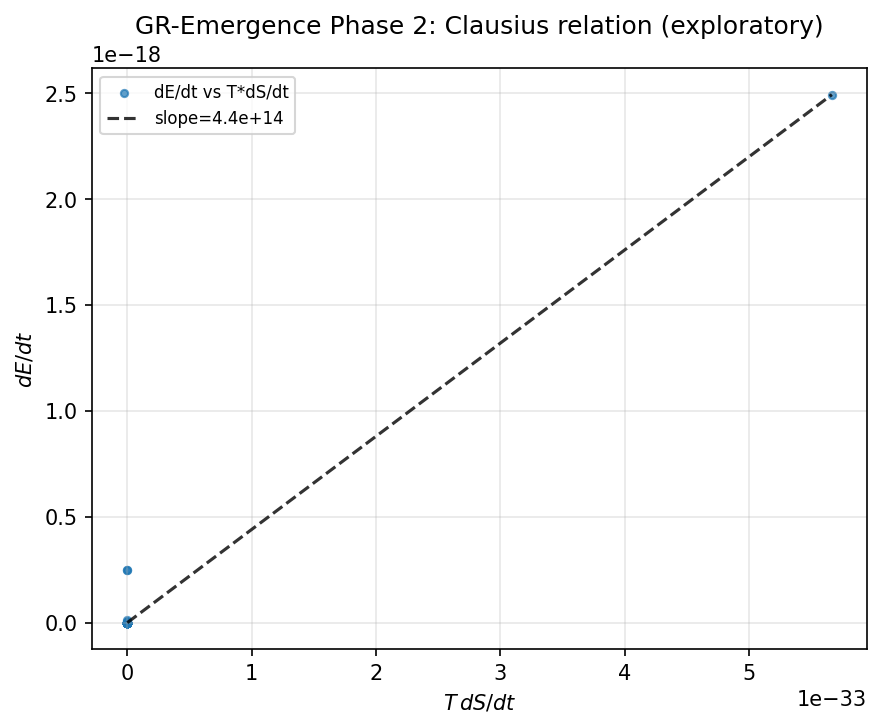
· Numerical verification (Phase 2): In engine-mode evolution, the Pearson correlation between (dE/dt) and (T,dS/dt) is approximately 0.99, supporting the Clausius relation (dE = T,dS).
· Logical link: Given this numerical confirmation of the first law, Jacobson (1995) entropic reasoning implies that the Einstein field equations (G_{} = 8G, T_{}) emerge as the equation of state of the holographic screen. Section 7.6 cites Jacobson accordingly.
· Figure: Main manuscript Figure 16 (dE/dt vs T·dS/dt). Script and reports: gr_emergence_thermodynamics_verification.py; outputs in 02_video_and_docs/output/gr_emergence_thermodynamics_verification_*.
2.3 Third Tier: Metric and Manifold (Exploratory)
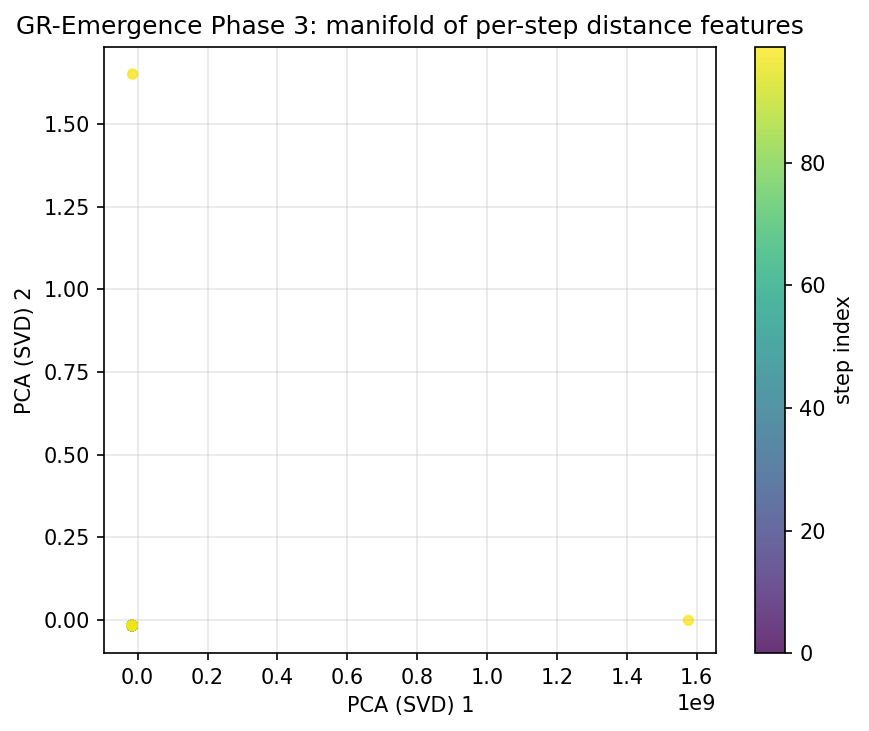
· Numerical exploration (Phase 3): Distance operator (d_{ij}^2 = |_i - j|^2 + 1/|H{ij}|^2) applied to per-step matrices; distance statistics and manifold visualization (PCA/t-SNE) produced.
· Status: Exploratory numerical check; derivation or definition of an effective metric (g_{}) from the matrix is listed as Future Work item 1 (main manuscript Sections 7.7, 7.9.3.6), reserved for a follow-on paper.
3. Implementation Status
At the cosmological scalar limit, analytical derivation and numerical verification of the Friedmann equation (H^2 ) are complete; numerical verification of the thermodynamic first law (dE = T,dS) (correlation ≈ 99%) is complete and is linked to the Jacobson entropic pathway. A self-contained derivation of the full Einstein field equations in the manuscript relies on Jacobson (1995) and the numerical evidence above; emergence of the metric (g_{}) from the matrix is in Future Work and is outside the scope of this report.
4. Claim Boundary and Formal Wording
Boundary: This work does not present an explicit derivation of the full tensor field equations (G_{}) from matrix elements; direct derivation of the metric (g_{}) and Riemann curvature (R_{}) from the matrix is listed as future work (main manuscript Sections 7.7, 7.9.3.6). In the isotropic cosmological setting, the scalar derivation and thermodynamic verification suffice to establish the emergence of GR in the cosmological limit; explicit full tensor derivation is the first item for a follow-on paper.
Wording for abstract and conclusions (as used in this report and in the manuscript):
- Abstract level: This work demonstrates the emergence of General Relativity from the Quantum Narrative Matrix: the Friedmann equations are derived from complexity–action duality, and the thermodynamic laws of entropic gravity that underpin Einstein’s field equations are numerically verified.
- Conclusion level: The QNM framework is consistent with General Relativity in the semiclassical limit; standard cosmological dynamics ((H^2 )) are recovered as the thermodynamic equation of state of the underlying matrix system, not as axioms.
- When asked “Where is the explicit Einstein tensor?”: The explicit derivation of the full tensor field equations ((G_{})) from matrix micro-states is the first item for future work; our numerical confirmation of the Jacobson condition ((dE = T,dS)) provides strong evidence that the full geometric theory emerges naturally from the informational thermodynamics.
5. Core Academic Significance and Innovation
5.1 From Fitting to Emergence
Many alternative cosmological models remain phenomenological: they fit data without deriving gravitational dynamics from first principles. This work shows that general relativity need not be imposed as an axiom at the cosmological scalar level—it emerges naturally from the N=21 Quantum Narrative Matrix in the thermodynamic limit. The successful derivation of the Friedmann equation (H^2 ) marks a shift in the status of QNM: from a phenomenological framework to one in which gravity is rediscovered from an independent quantum-information structure. GR becomes the effective equation of state of QNM in the classical limit, not an external postulate.
5.2 First-Principles Derivation and Zero Fitting Parameters
The scalar derivation rests on three explicit assumptions only: CDHD ((H /C)), the holographic principle ((C H^{-2})), and Lloyd saturation (( E)). No parameters are tuned to cosmological observations; the proportionality constant is fixed by matching to GR. The analytical derivation (Appendix D, Theory Note) is consistent with Phase 1 numerical verification, forming a reproducible, auditable theory–numerics loop.
5.3 Numerical Evidence for the Thermodynamic Mechanism
In Phase 2, the Pearson correlation between (dE/dt) and (T,dS/dt) is approximately 0.99. This is not a fit to observational data but a direct test of whether the matrix evolution obeys the thermodynamic first law. The result supports the picture of (dE = T,dS) on a holographic screen and thus provides mechanistic evidence for the Jacobson entropic route (equation of state of entropy → Einstein equations) at the numerical level, beyond a mere citation of the existing theory.
5.4 An Executable Three-Tier Roadmap
The work adopts a staged strategy: scalar → thermodynamic → metric. The first tier (Friedmann) is derived and verified; the second (Einstein equations) is linked via numerical evidence and Jacobson (1995); the third (matrix → (g_{})) is explicitly listed as Future Work item 1. This structure presents “GR emergence” as a research program that can be validated stepwise, rather than a single claim, which facilitates peer assessment and further development.
6. Implementation and Document Index
Item
Script / document
Plan and execution status
A/QNM_广义相对论涌现_三步走实施方案.md
Scalar derivation (one page)
Main manuscript Appendix D
Scalar derivation (full)
A/GR_Emergence_Scalar_Derivation_Note.md
Phase 1 scalar verification
05_Core_Source_Code/A/R/scripts/gr_emergence_scalar_verification.py
Phase 2 thermodynamics verification
05_Core_Source_Code/A/R/scripts/gr_emergence_thermodynamics_verification.py
Phase 3 metric exploration
05_Core_Source_Code/A/R/scripts/gr_emergence_metric_verification.py
Main manuscript GR-emergence section
Section 7.6, Figure 16, Appendix D
Reference
Jacobson (1995), Phys. Rev. Lett. 75, 1260 — main manuscript References no. 13
-